
Application Case of Reverse Osmosis Equipment in Anhui Jinguan Glass Production Plant
1. Project Overview
The cooperating enterprise for this case is Anhui Jinguan Glass Co., Ltd., a long-standing, medium-sized private glass enterprise founded in 1972 (formerly known as Huaibei Glass Factory). Located in the Fenghuangshan Economic Development Zone, Huaibei City, the company covers an area of more than 260 mu. Integrating glass R&D, production, deep processing, and sales, it mainly produces high- and medium-grade daily-use glassware, glass bottles, glass jars, and craft glass products. Equipped with 5 high-efficiency, energy-saving kilns and 16 automated production and deep-processing lines, it maintains an annual production capacity of 80,000 tons of glass products. As a local high-tech enterprise and quality integrity benchmark, its products sell well both domestically and internationally.
The daily-use glassware, food-grade glass bottles, and craft fired glass products produced by Jinguan Glass must meet extremely strict requirements for high cleanliness and food-grade production water quality. The municipal raw water contains calcium and magnesium ions, suspended solids, trace impurities, and dissolved salts. In the processes of post-forming fine cleaning, firing pretreatment, finished product cleaning, and equipment circulating cooling, these substances easily form water spots, white dots, and water stains on the surface of the glassware. This results in substandard light transmittance, poor smoothness, and high product defect rates. Meanwhile, high-hardness raw water causes scaling and blockages in production spray pipelines, kiln cooling equipment, and cleaning machine nozzles. This not only affects production accuracy but also accelerates equipment wear and increases shutdown maintenance frequency, seriously restricting product quality and production capacity stability.
With the intelligent workshop upgrading and full-load operation of the production lines, the plant’s daily consumption of purified water increased significantly. The original water purification equipment in the plant adopted outdated technology, resulting in unstable effluent water quality, a failure to meet cleanliness standards for food-grade glass production, a low water recovery rate, and high operation and maintenance (O&M) costs. In addition, the direct discharge of concentrated water caused serious water resource waste, failing to meet the enterprise’s goals for green production and environmental compliance.
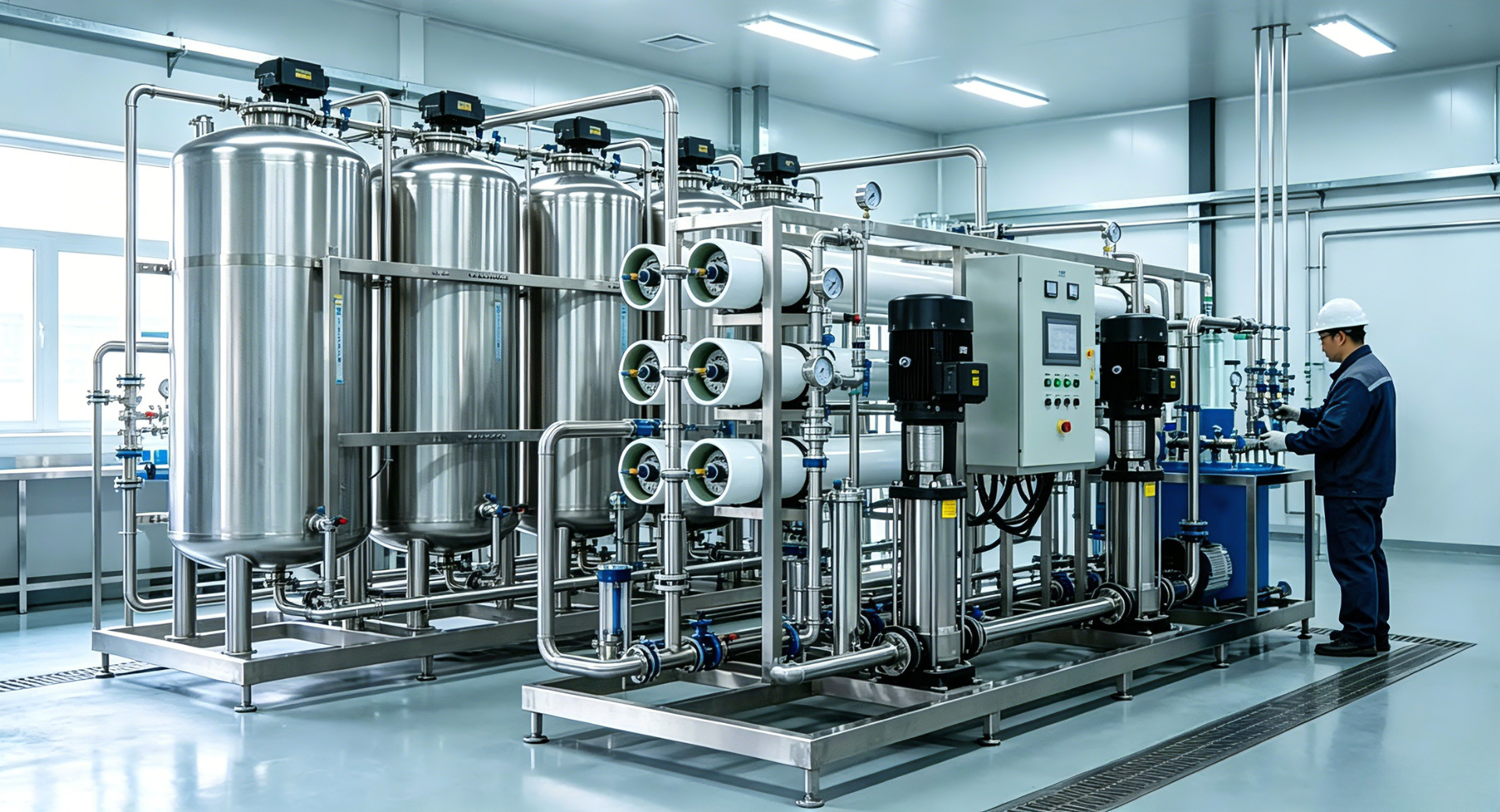
To fundamentally improve the yield of qualified daily-use glass products, reduce equipment O&M costs, achieve water savings, and comply with food-grade glass production water quality specifications, Anhui Xinke Water Treatment Equipment Co., Ltd. was contracted to design, manufacture, and commission a complete turnkey solution. Anhui Xinke customized and installed a set of high-configuration, intelligent double-stage reverse osmosis (RO) pure water equipment systems, complete with full pretreatment, concentrated water reuse, and an automatic intelligent control system to fully meet the water demands of the entire glass production process.
2. Core Project Pain Points
- Prominent Product Quality Defects: Without advanced purification, raw water contains excessive salts and impurities that leave watermarks, white dots, and water spots on cleaned glassware and food-grade bottles. For craft fired and painted glass products, surface defects and inconsistent finish smoothness often occur, leading to a high defect rate for high-end customized glass products, harming brand reputation, and disrupting order delivery.
- Severe Equipment Loss: Calcium and magnesium hardness ions easily scale on the inner walls of spray pipelines, nozzles, and cooling equipment. This causes pipeline blockages, uneven spraying, frequent equipment failures, and shutdowns, which spikes annual maintenance costs.
- Serious Water Resource Waste: The plant’s original water purification equipment had a water recovery rate of only about 55%. A large volume of concentrated water was directly discharged, resulting in high water procurement costs and a failure to meet industrial water-saving and environmental protection requirements.
- Unstable Water Quality: Traditional water purification equipment delivered fluctuating effluent water quality that could not stably meet the high-cleanliness water standards for food-grade daily-use glass and craft glass deep processing. Cleaning quality between different product batches varied greatly, making it difficult to adapt to standardized and intelligent production management requirements.
3. Solutions and Equipment Configuration
Combined with national industrial water quality standards for the glass industry and the actual water conditions of the plant, Anhui Xinke Water Treatment Equipment Co., Ltd. deployed a mature, proprietary process layout: Multi-stage Pretreatment + Double-stage Reverse Osmosis + Concentrated Water Reuse + Automatic Intelligent Control System. The effluent quality, water yield, and operational stability of this complete system fully adapt to the full-load production demands of Jinguan Glass’s production lines.
3.1 Core Process Flow
Raw water tank -> Raw water booster pump -> Multimedia filter -> Activated carbon filter -> Softening filter -> Precision security filter -> First-stage reverse osmosis system -> Second-stage reverse osmosis system -> Pure water pressure stabilizing tank -> Production water points.
The concentrated water produced by the reverse osmosis system is collected, treated via Disc Tube Reverse Osmosis (DTRO) concentration, and reused in preliminary processes such as rough glass cleaning and factory floor cleaning to realize the recycled utilization of water resources.
3.2 Key Equipment Configuration and Functions (Engineered by Anhui Xinke)
- Advanced Three-Stage Pretreatment: Anhui Xinke integrated a multimedia filter to intercept sediment, suspended solids, and colloids; an activated carbon filter to adsorb residual chlorine, organic matter, color, and odor (preventing oxidation of the RO membranes); and a resin softening filter to completely remove calcium and magnesium ions, reducing raw water hardness and preventing downstream scaling.
- Precision Security Filtration: A 5-micron precision security filter intercepts tiny remaining impurities post-pretreatment. This protects the core reverse osmosis membrane elements from blockages and mechanical scratch damage, ensuring stable system run-times.
- High-Configuration Double-Stage RO Host: Featuring premium, high-rejection RO membrane elements, the first-stage RO achieves a 75% recovery rate (removing over 98% of dissolved salts and heavy metals). The second-stage RO reaches an independent recovery rate of 85%, deeply purifying water and drastically dropping conductivity. The system features an energy-saving variable frequency high-pressure pump that automatically adjusts operating power based on real-time water demand.
- Smart Control & Automation: Built around a high-end Siemens PLC system, the equipment supports automatic start-stop, constant-pressure water supply, automatic chemical flushing, fault alarms, and water-shortage protection. It enables full-process, 24/7 unattended operation with clear, accessible, and traceable water quality, pressure, and flow data.
- Concentrated Water Reuse System: Instead of traditional direct discharge, the reverse osmosis concentrated water is reclaimed and routed back into the factory for rough glass cleaning, cooling tower makeup water, and floor flushing, maximizing the plant’s water utilization rate.
4. Project Operating Parameters and Effluent Standards
- Equipment Water Production Capacity: Rated pure water yield is 20 m³/h, which easily satisfies the simultaneous peak water demands of multiple glass production lines in the plant.
- Effluent Water Quality: The resistivity of the pure water is stably maintained at >= 15 MΩ·cm, and the conductivity is <= 10 μS/cm. The water is clean, free of impurities, and free of salt residues, fully complying with the strict production water specifications for food-grade daily-use glass and deep-processed craft glass.
- Comprehensive Water Recovery Rate: Following Anhui Xinke’s equipment commissioning, the plant’s overall water recovery rate increased from 55% to 82%, significantly reducing raw water consumption and wastewater discharge fees.
- Operational Stability: The equipment operates continuously 24 hours a day with negligible water quality fluctuation. The annual stable operational rate is >= 99%, completely eliminating frequent fault shutdowns.
5. Project Implementation Effects and Benefit Analysis
5.1 Quality Benefit: Greatly Reduced Product Defect Rate
After Anhui Xinke’s system was put into operation, the production water at Jinguan Glass realized strict standardization, high cleanliness, and absolute stability. It completely eliminated quality defects such as water spots, white dots, stain residues, and substandard smoothness on the glassware surface. It also eliminated finished product defects in downstream deep-processing procedures like firing, painting, and frosting.
Key Performance Indicator: The comprehensive product defect rate of daily-use glass, food bottles, and jars dropped sharply from 4.2% to less than 0.8%, significantly boosting the yield of high-end, customized craft glass.
5.2 Cost Benefit: Water Saving, Consumption Reduction, and Lower O&M Costs
- Water Savings: The application of the concentrated water reuse system saves more than 30,000 tons of industrial water annually, drastically reducing tap water procurement costs and wastewater discharge fees.
- Asset Protection: The combined softening and reverse osmosis process completely solved the equipment scaling problem. The failure rate of production spray pipelines, nozzles, and cooling equipment dropped by 80%, slashing annual equipment maintenance and replacement costs.
- Energy Efficiency: The integrated variable frequency energy-saving system reduced equipment power consumption, lowering overall production and system O&M costs by more than 25%.
5.3 Production Benefit: Ensuring Continuous and Efficient Production
The fully automatic reverse osmosis system engineered by Anhui Xinke requires no full-time on-site operators. Its intelligent start-stop, automatic flushing, and fault early-warning functions effectively prevent water cutoffs or out-of-specification water quality caused by manual operational errors. It guarantees stable, 24-hour manufacturing on the production lines, eliminating unexpected downtime and improving overall plant production efficiency by more than 15%.
5.4 Environmental Benefit: Compliance Emission Reduction and Green Production
The wastewater discharged by the system fully complies with national discharge standards. The water resource recycling mode conforms to national industrial green production, water-saving, and emission-reduction policies. This helps the enterprise smoothly pass environmental protection inspections, avoid regulatory penalty risks, and establish an exemplary corporate image as a green manufacturer.
6. Project Summary & Key Takeaways
The reverse osmosis pure water equipment renovation project at the Anhui Jinguan Glass production plant accurately solved the core industry challenges of insufficient water cleanliness, rapid equipment scaling, water resource waste, and unstable product quality.
Key Project Highlights:
High Industry Reference Value: This case demonstrates the exceptional applicability of Anhui Xinke’s water treatment equipment within the daily-use glass, food-grade glassware, and glass bottling industries. It proves that upgrading to intelligent water treatment systems is a reliable path for manufacturing enterprises to achieve intelligent upgrading, quality improvement, and green compliant production.
Turnkey Execution by Industry Expert: The entire project—including process R&D, structural design, equipment manufacturing, on-site installation, and final system commissioning—was successfully executed by Anhui Xinke Water Treatment Equipment Co., Ltd.
High-Configuration Components: Built utilizing corrosion-resistant materials (such as stainless steel 316L and robust PVC piping) and high-end automation components to guarantee stable operation in harsh industrial environments.
Exceptional Efficiency: Boosted the plant’s overall water recovery rate to 82% while driving down the comprehensive product defect rate to under 0.8%.
High Industry Reference Value: This case demonstrates the exceptional applicability of Anhui Xinke’s water treatment equipment within the daily-use glass, food-grade glassware, and glass bottling industries. It proves that upgrading to intelligent water treatment systems is a reliable path for manufacturing enterprises to achieve intelligent upgrading, quality improvement, and green compliant production.