Get Professional Water Solutions
Customized Designs For Seawater Desalination & Automatic Filling Systems.
Customized Designs For Seawater Desalination & Automatic Filling Systems.
Customized Designs For Seawater Desalination & Automatic Filling Systems.
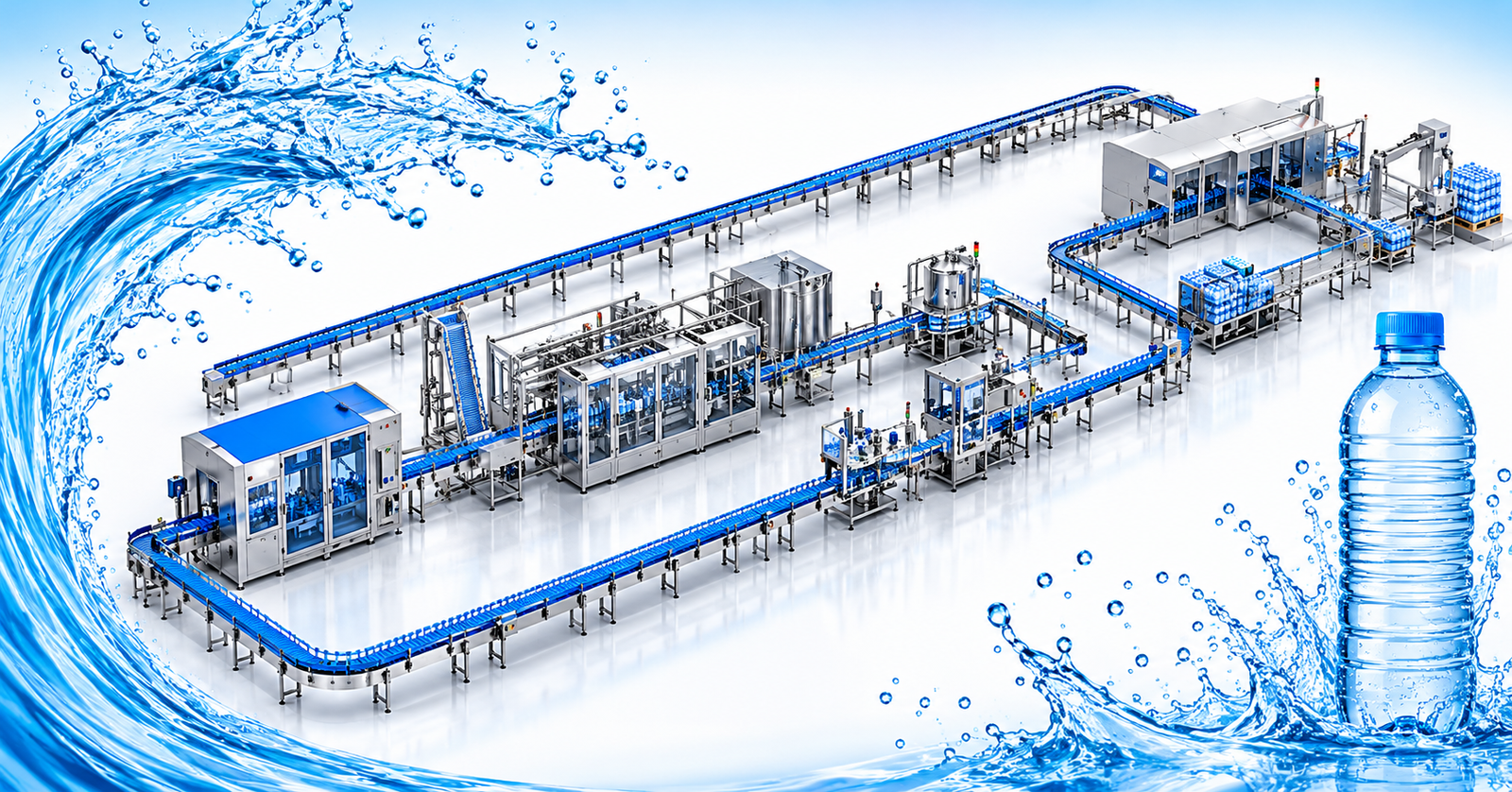
A complete technical guide to designing, specifying and commissioning a mineral water bottling plant in Europe — from spring capture and filtration through reverse osmosis, PET blow molding, filling, capping, labelling, packaging and automated palletizing. Written for producers, project engineers and investors who need numbers, standards and decision points, not marketing language.
In this guide
- Anatomy of a modern mineral water bottling line
- Stage 1 — Source protection and abstraction
- Stage 2 — Filtration, RO and permitted treatment
- Stage 3 — PET blow molding (and the glass alternative)
- Stage 4 — Filling, capping and hygiene control
- Stage 5 — Labelling, coding and traceability
- Stage 6 — Secondary packaging and case packing
- Stage 7 — Automated palletizing and warehouse automation
- Utilities, energy and water recovery
- The European compliance framework in 2026
- Capacity selection and indicative CAPEX
- Project delivery, FAT/SAT and validation
- The digital layer: MES, OEE and predictive maintenance
- How to specify and buy a turnkey line
- Frequently asked questions
Europe is the world’s most demanding bottled water market, and not because of volume alone. Natural mineral water is a regulated category with a protected legal status, recognised at source and subject to hydrogeological surveillance, permitted-treatment limits and labelling rules that no other region applies with the same rigour. Retail chains add a second layer through BRCGS and IFS audits, and packaging legislation now sets design constraints that reach right back into the specification of a blowing machine and a shrink wrapper.
The practical consequence is that a European mineral water bottling plant is engineered as a validated system, not as a set of machines placed end to end. Every unit operation must be defensible to three audiences at once: the national competent authority that recognises the spring, the retailer’s technical auditor, and the line’s own HACCP study. That is why lines built for Europe look over-engineered to buyers from less regulated markets — and why those same lines hold their value, pass audits first time and run at higher overall equipment effectiveness (OEE) a decade later.
The market itself is mature but not static. Still water dominates volume, sparkling and lightly carbonated segments keep growing, small-format 0.5 L PET remains the retail workhorse, and returnable glass persists in Germany, Austria and parts of Central Europe where deposit return schemes reward reuse. Lightweighting, recycled PET content and packaging reduction are the three forces now reshaping line design more than raw speed does.
A mineral water line is a chain of seven process blocks, each with its own failure modes and its own compliance evidence. Understanding the chain as a single hydraulic and hygienic system — rather than a shopping list — is what separates a line that runs at 92% availability from one that stalls every shift.
| Process block | Core equipment | Performance indicator |
|---|---|---|
| Abstraction & storage | Spring capture chamber, hygienic buffer tanks, level and conductivity monitoring | Water loss < 1% between capture and filler |
| Treatment | Multimedia filtration, activated carbon, cartridge polishing, UF/RO, UV | Turbidity < 0.2 NTU at filler inlet |
| Blow molding | Preform unscrambler, IR heater, blow wheels or linear station, moulds | Wall-thickness tolerance ± 0.1 mm; scrap < 2% |
| Filling & capping | Monoblock rinser-filler-capper, cap feeder and chute, CIP/SIP circuit | Fill accuracy ± 1 mL on 500 mL; cap torque 1.2–2.0 N·m |
| Labelling | Roll-fed OPP labeller or sleeve applicator, laser or CIJ coder | Placement accuracy ± 0.5 mm; code readability > 99.5% |
| Secondary packaging | Shrink wrapper, tray packer, wrap-around case packer, handle applicator | Film thickness 40–50 µm; pack integrity at 1.2 m drop |
| Palletizing | Layer palletizer or 4-axis robot, pallet dispenser, stretch wrapper or hooder | 8–12 cycles per minute; pallet pattern repeatability < 2 mm |
A complete turnkey mineral water bottling plant therefore integrates four engineering disciplines: process water treatment, packaging machinery, hygienic building services, and automation with traceability. The sections below take each block in sequence, with the parameters that actually decide cost and performance.
Everything downstream is a function of what the spring gives you. In Europe, a natural mineral water must be extracted from a protected aquifer, recognised by the competent authority of the member state, and demonstrated to be stable in composition. That recognition is not a formality — it determines whether you may sell the product as “natural mineral water” at all, and it constrains what you are allowed to do to it later.
The engineering work at this stage is unglamorous and decisive:
Two mistakes recur in greenfield projects. The first is undersizing the buffer tank, which forces the treatment plant to follow the filler’s instantaneous demand and produces pressure swings that destabilise UV dose and membrane recovery. The second is ignoring water temperature: European spring water is often 8–12 °C at capture, and every degree of warming in an uninsulated buffer tank is an invitation for microbiological growth. Insulated, dark, continuously recirculated storage is the standard answer.
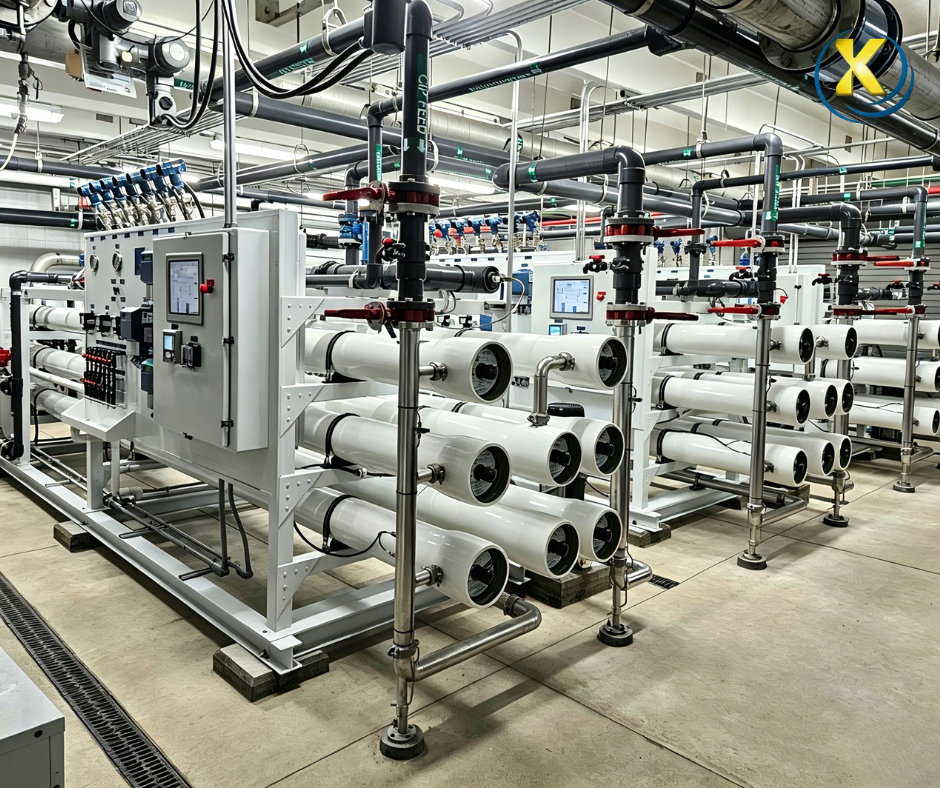
A containerised treatment skid: multimedia and carbon vessels, 5/1 µm cartridge polishing, RO array and UV barrier — the compliant treatment core of a European mineral water plant.
This is where technical ambition most often collides with law. For natural mineral water under Directive 2009/54/EC, the permitted treatments are narrow: separation of unstable elements such as iron, manganese and sulphur compounds, aeration, filtration, and — where nationally authorised — ozone-enriched air. Disinfection of the product is not permitted, and neither is anything that changes the mineral composition. Reverse osmosis, demineralisation and softening are therefore excluded from the product path.
RO does have a legitimate and important role in a mineral water plant, but in three other places: process and utility water (bottle rinsing, CIP final rinse, steam generation, cooling), feed water for table or prepared waters where the legal category permits it, and concentrate management loops. Specifying this distinction correctly at the concept stage avoids a redesign after the first audit.
| Technology | Removes / controls | Typical recovery | When it belongs in the train |
|---|---|---|---|
| Multimedia filtration | Turbidity, suspended solids, iron, manganese | 95–98% | Raw water with visible solids or elevated Fe/Mn |
| Activated carbon (GAC) | Odour, taste, chlorine, organic matter, THM precursors | ~95% | Municipal or chlorinated feed; taste-critical products |
| Cartridge polishing (5 µm / 1 µm) | Residual particles, protect UV and membranes | 98%+ | Always, immediately upstream of UV or RO |
| Ultrafiltration (UF) | Colloids, bacteria, cysts, high-molecular organics | 85–92% | Surface-influenced sources, high and variable turbidity |
| Reverse osmosis (RO) | TDS, nitrate, sulphate, hardness, many pesticides and pharmaceuticals | 70–80% (low-salinity feed) | Brackish feed, process water, table/prepared water — not natural mineral water |
| UV 254 nm | Bacteria, viruses, spores | No water loss | Final barrier on every product path; 40–60 mJ/cm² validated dose |
| Ozone | Colour, iron, manganese, disinfection | No water loss | Only where the product category and national rules allow; watch bromate |
| Mineralisation / blending | Restores Ca, Mg, bicarbonate after RO | — | Table and prepared waters; food-grade salts with closed-loop dosing |
For a 10,000 bph PET water line, a treatment train of 12–18 m³/h product flow plus 4–6 m³/h utility water is a typical starting point, with the buffer sized so that CIP peaks do not starve the filler.
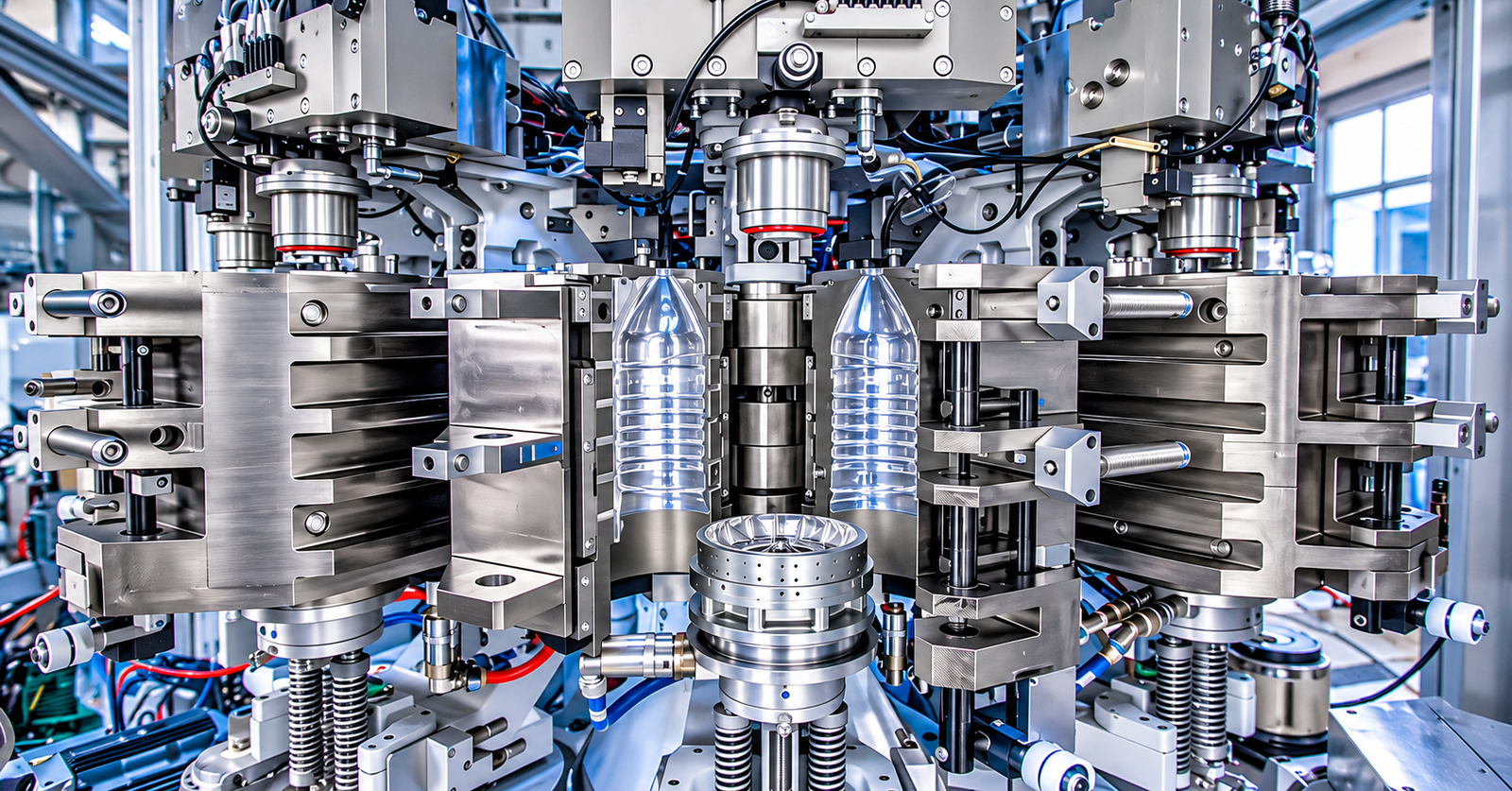
Linear stretch blow molding: preform heating, conditioning, stretch and blow, with freshly formed bottles transferring neck-down to the filler infeed.
Blow molding converts a 12–18 g preform into a 6–10 g bottle, and it is the most energy-intensive mechanical step on the line. Two architectures dominate:
Beyond architecture, four parameters decide whether the machine earns its place:
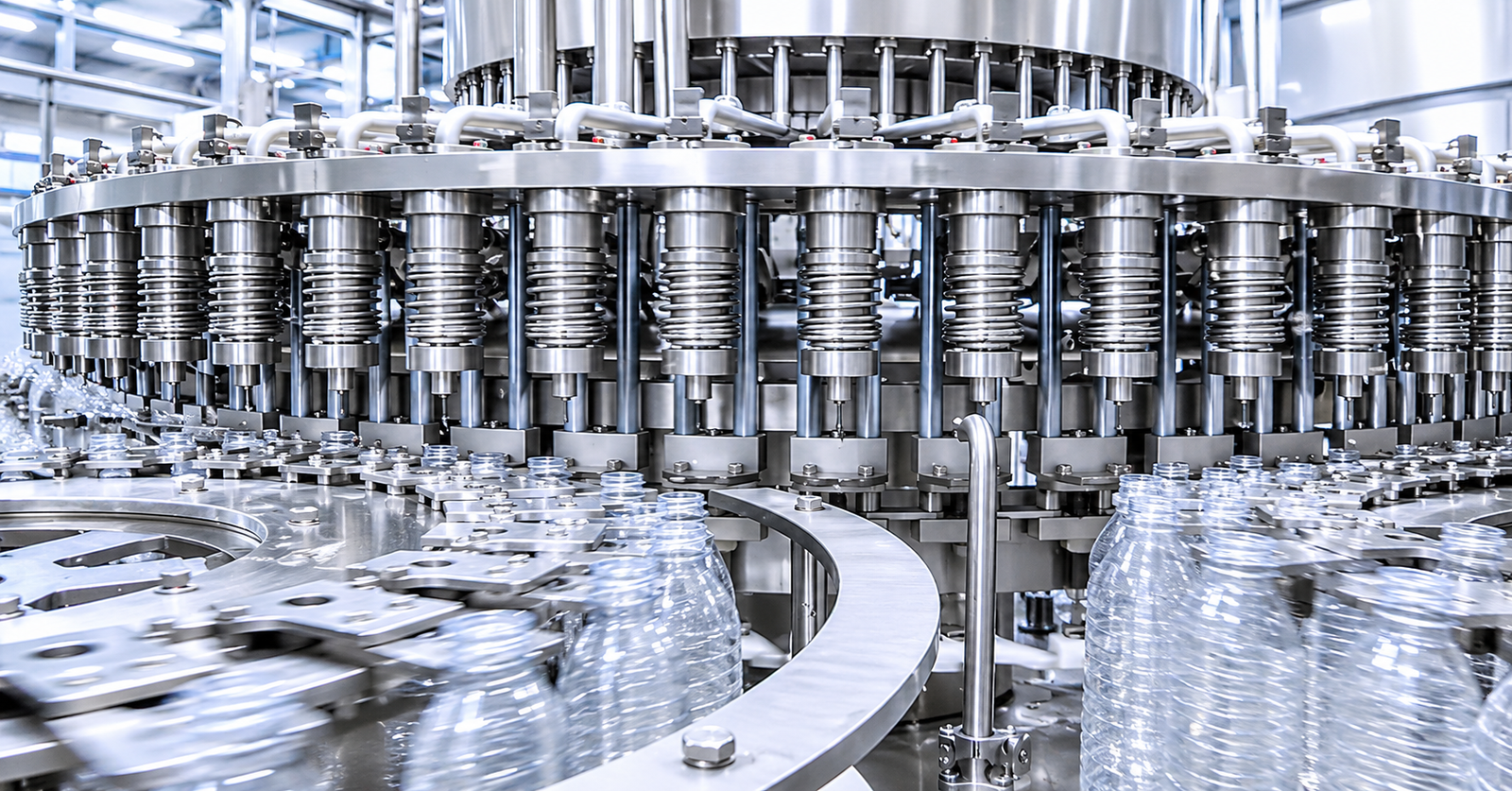
Rotary monoblock: rinser, gravity filler and capper on one servo-synchronised frame, with laminar flow cabinets over the open product zone.
For still water, filling is a low-vacuum or gravity operation at ambient temperature; for carbonated water it becomes pressure filling at 3–5 bar with a CO₂ counter-pressure cycle. In both cases the monoblock — rinser, filler and capper on one frame with a single drive — is the European standard, because it removes the transfer star wheels where contamination and damage happen.
For sparkling products, the filler is also the point where dissolved CO₂ is set. Carbonation accuracy of ± 0.1 g/L and a stable CO₂ profile through the filler bowl determine whether the pack still reads as “lightly carbonated” after six months on a warm shelf.
The label carries legal weight in Europe: the name of the source, the statement of mineral composition, the recognition number, batch and best-before information. That makes labelling a compliance function as much as a decoration function.
Under PPWR, labels and sleeves are also part of the recyclability assessment. Designing for separation now is cheaper than retrofitting a sleeving line later.
This is the block most often bought last and regretted first. Packaging determines pallet density, transport cost and — increasingly — legal compliance.
PPWR, applicable from 12 August 2026, adds three design constraints that reach into this block: recyclability of all packaging placed on the EU market, minimum recycled content for plastic packaging (including beverage bottles), and limits on empty space in grouped and transport packaging. In practice, that means specifying film and board that are mono-material where possible, documenting recycled content per component, and keeping pack geometry tight enough to pass the empty-space test.
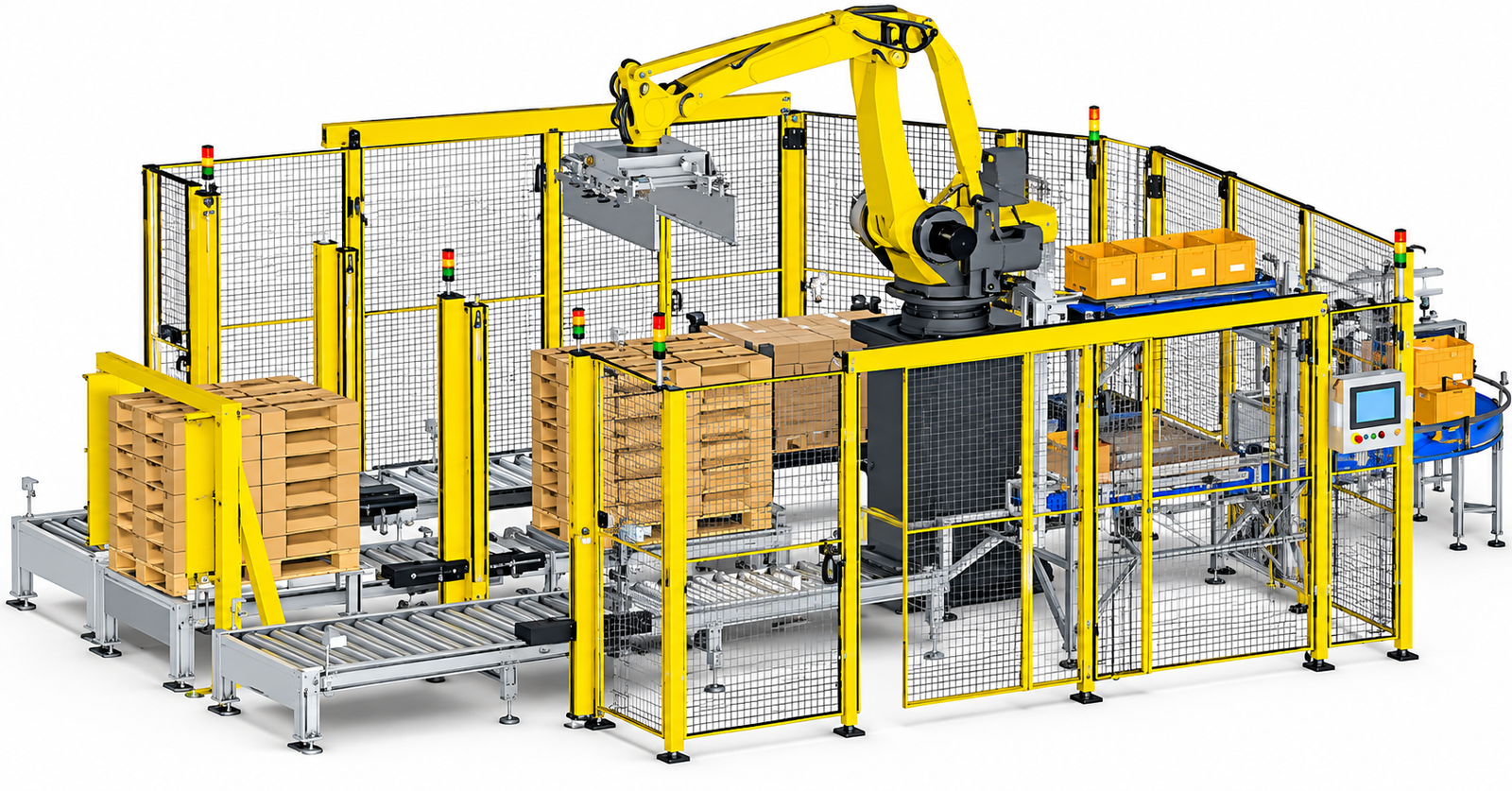
End of line: shrink-wrapped packs, an automatic case packer and a robotic palletizer with stretch hooding — the point where labour cost and pallet quality are decided.
Palletizing is where a line stops being a machine and becomes a logistics system. Two options dominate, and the choice is driven by pattern complexity rather than speed alone.
| Solution | Output | Strengths | Best fit |
|---|---|---|---|
| Layer palletizer | Up to 25–30 packs/min | Simple patterns, high uptime, low maintenance, compact | Single-SKU, high-volume water lines |
| Robotic palletizer (4-axis) | 8–12 cycles/min | Flexible patterns, multiple SKUs and pallet types, gentle handling | Multi-format plants, co-packers, shared pallets |
| Hybrid / twin-robot cell | 18–22 cycles/min | Redundancy, mixed pallets, smaller footprint per cycle | Lines above 20,000 bph with SKU proliferation |
Around the palletizer sit the systems that determine whether the whole line works: pallet dispenser and magazine, slip-sheet and top-board placement, stretch wrapping or stretch hooding, weigh-check and label verification, and a pallet conveyor network that buffers at least 15–20 minutes of production. Stretch hooding costs more per pallet than wrapping but delivers better load stability and weather protection and is increasingly preferred for export.
Downstream, light goods vehicles or AGVs move pallets to a high-bay or block warehouse under WMS control. The rule of thumb: automate palletizing first, warehouse second. A robotic palletizer pays back in 18–30 months on two-shift operation in most European labour markets; an automated warehouse rarely pays back below 20,000 pallets per month.
Utilities are the difference between a plant that looks efficient and one that is. The table below gives indicative consumption for a modern PET still-water line at 10,000–20,000 bph, per 1,000 litres of finished product.
| Utility | Indicative consumption | Where it goes | Recovery opportunity |
|---|---|---|---|
| Electricity | 40–90 kWh | Blowing and HP air 45–60%, filling and conveyors 15–20%, packing 10–15%, treatment 8–12% | Air recovery, IE4/IE5 motors, VFD on conveyors, compressed-air leak programme |
| Raw water intake | 1.5–2.2 m³ | Product, bottle rinsing, CIP, RO feed | Rinse-water reuse, RO concentrate reuse, CIP optimisation |
| Wastewater | 0.3–0.8 m³ | RO concentrate, CIP caustic/acid, rinses | Neutralisation, concentrate reuse, segregated drains |
| Thermal energy | 50–150 kWh (thermal) during CIP and hot-water cycles | Cleaning, hot rinse, building services | Heat recovery from compressors and blow-air cooling |
Figures are indicative ranges for specification and budgeting; actual values depend on bottle weight, blowing technology, air recovery and CIP regime.
Three measures separate a modern European plant from a 2010-vintage one: blow-air recovery (30–50% less high-pressure air), closed-loop bottle rinsing (rinse water reused for the next rinse stage rather than drained), and per-SKU energy metering on the main drives. The third is the cheapest and most under-used: you cannot manage kWh per 1,000 bottles if the line only has one meter at the main incomer.
A mineral water bottling plant sold into Europe must satisfy a stack of instruments that cut across process, machine safety, materials and packaging. This table is the working checklist we use during specification.
| Instrument | What it governs | What it means for the line |
|---|---|---|
| Directive 2009/54/EC | Exploitation and marketing of natural mineral waters | Source recognition, permitted treatments, labelling of composition and source |
| Regulation (EU) 2020/2184 | Water intended for human consumption | Utility and process water quality, materials in contact, risk-based monitoring |
| Regulation (EC) 852/2004 + HACCP | Food hygiene | Hygienic design, zoning, cleaning validation, prerequisite programmes |
| Regulation (EC) 1935/2004, 10/2011, 2022/1616 | Food-contact materials and recycled plastics | Preform, cap, label and film declarations; authorised rPET processes and closed-loop control |
| Regulation (EU) 2023/1230 | Machinery safety (successor to the Machinery Directive, applicable from January 2027) | CE marking, EN ISO 12100 risk assessment, safety PLC and guarding, digital instructions |
| Regulation (EU) 2025/40 (PPWR) | Packaging and packaging waste | Recyclability, recycled content, empty-space limits, labelling of material |
| Directive (EU) 2019/904 | Single-use plastics | Tethered caps up to 3 L since July 2024; 25% recycled PET in bottles since 2025 |
| EN 1672-2 / EN ISO 14159 / EHEDG | Hygienic design of machinery | Cleanability, drainability, surface finish, no dead legs |
| ISO 22000, FSSC 22000, BRCGS, IFS | Certification schemes demanded by retailers | Traceability, foreign-body control, allergen-style segregation, supplier approval |
Two practical notes. First, CE marking is the supplier’s obligation, not the buyer’s — but the technical file must include the line’s risk assessment, and buyers who never ask to see it discover the gap during the retailer audit. Second, the deposit return schemes spreading across member states change the commercial case for returnable glass and for refill formats; a line specified without that consideration can be technically perfect and strategically wrong.
Capacity is usually set by the sales plan rather than by the spring, and it is almost always overestimated at the start. A useful discipline is to specify for year-three volume at 70% utilisation, not for year-one optimism at 95%.
| Line capacity | Typical formats | Footprint (production + utilities) | Indicative CAPEX (EUR, ex-works, 2026) | Typical fit |
|---|---|---|---|---|
| 2,000 bph | 0.5–1.5 L PET | 600–900 m² | 250,000–450,000 | Regional spring, private-label start-up |
| 5,000 bph | 0.5–2.0 L PET | 1,000–1,500 m² | 650,000–950,000 | Regional brand, first own-label growth |
| 10,000 bph | 0.5–2.0 L PET, 0.75 L glass | 1,800–2,800 m² | 1,200,000–1,800,000 | National brand, retail supply |
| 20,000 bph | 0.5–1.5 L PET | 3,000–5,000 m² | 2,400,000–3,800,000 | Large brand, co-packing |
| 30,000–40,000 bph | 0.5–1.5 L PET, high-cavity blowing | 5,000–8,000 m² | 4,500,000+ | Multi-national, multi-line campus |
Indicative ranges only, excluding building, civil works, utilities installation, permits and working capital. Actual quotations vary ± 30% with scope, hygienic level, automation and country of manufacture.
The calculation that matters more than CAPEX is cost per 1,000 bottles at the filler. Two lines with the same price tag can differ by 25% in operating cost through air recovery, bottle weight, film consumption and OEE. Ask every supplier for the same four numbers: kWh per 1,000 bottles, grammes of PET per bottle, grammes of film per pack, and demonstrated OEE at SAT.
| Phase | Duration | Deliverable |
|---|---|---|
| Feasibility, water analysis, concept | 4–6 weeks | Water profile, capacity study, line configuration, utility budget |
| Basic and detail engineering | 8–12 weeks | P&ID, layout, electrical architecture, hygienic zoning plan, CIP schedule |
| Manufacturing and FAT | 12–18 weeks | Factory acceptance test at rated speed, documentation pack, CE technical file |
| Installation | 6–10 weeks | Mechanical and electrical completion, utilities connected, safety circuits verified |
| Commissioning and SAT | 4–6 weeks | Rated output sustained, fill accuracy, cap torque, OEE baseline, operator training |
| Validation and certification | 4–8 weeks | HACCP validation, microbiological and chemical release testing, retailer audit readiness |
Total elapsed time for a new line is typically 9–14 months from purchase order to successful SAT. A greenfield plant adds building, permits and source recognition, which is why 18–24 months is the realistic planning horizon for a completely new site.
Write the acceptance criteria into the contract, not into the commissioning week. Rated speed for 72 hours, fill accuracy at three bottle formats, cap torque distribution, noise at operator positions, scrap rate and changeover time are all measurable — and all negotiable before signature rather than after.
Modern European lines are bought with a data architecture, because retail customers and energy contracts both demand it.
A specification that survives audits and tenders contains the following, in writing:
The most expensive mistake in this market is buying machines that work individually but were never engineered as a line. Conveyor buffering, accumulation logic, reject handling and CIP scheduling are system decisions, and they are exactly the items that disappear from a machine-by-machine purchase.
A complete PET line runs from roughly EUR 250,000–350,000 at 12000 bph to EUR 2.4–3 million at 60,000 bph, ex-works and excluding building and utilities. Greenfield projects typically add 40–70% for civil works, utilities, warehouse, laboratory and permits. The dominant variables are capacity, hygienic level, automation and whether treatment includes RO.
Specify for year-three volume at around 70% utilisation. Most regional brands land between 5,000 and 10,000 bph; 2,000 bph suits private-label or a single-source niche; 20,000 bph and above only makes sense with multi-shift operation and confirmed retail listings.
No. Under Directive 2009/54/EC, natural mineral water may only undergo separation of unstable elements such as iron, manganese and sulphur compounds, plus aeration and filtration. RO, demineralisation and disinfection would change its composition and are not permitted. RO is used for process water, bottle rinsing, CIP and utility loops, or for table and prepared waters where the category allows.
Typically 9–14 months from purchase order to successful site acceptance for a new line, with 12–18 weeks of manufacturing and FAT in the middle. A completely new greenfield site, including building and source recognition, should be planned at 18–24 months.
CE marking under the machinery rules, food-contact compliance for preforms, caps, labels and film, and hygienic design to EN 1672-2. Retailer-facing schemes — BRCGS, IFS, FSSC 22000 — are plant certifications rather than machine certifications, but they audit the line’s cleanability, traceability and foreign-body controls, so the specification has to anticipate them.
Not practically. Filling, capping, conveying and inspection differ fundamentally, and glass adds a bottle washer and empty-bottle inspection. Dual-format plants normally run separate lines sharing treatment, utilities and palletizing, which is why layout planning should reserve that space from day one.
PPWR (EU) 2025/40 applies from 12 August 2026 and introduces recyclability requirements, recycled-content obligations and empty-space limits for grouped packaging, with further obligations phasing in to 2030. Combined with the tethered-cap requirement in force since July 2024 and the 25% recycled PET content already required, packaging design now determines machine specification — cap chutes, film grades, label materials and pallet patterns all follow from it.
Roughly 1,800–2,800 m² of production and utility space, plus warehouse. Utility budgets are typically 40–90 kWh and 1.5–2.2 m³ of raw water per 1,000 litres of finished product, with high-pressure air for blowing as the largest single electrical load.
Send us your water analysis, target formats and capacity, and we will return a line configuration, utility budget and indicative capex built around the legal category you intend to sell under — not a generic equipment list.
AhSinc Water Treatment & Turnkey Lines
Email: sales@watertreattech.com | WhatsApp: +86 185 5579 2932

WeChat ID: 13966123546
Scan to Chat