
High-Capacity SWRO Desalination Systems: Engineering Architecture & Plant Optimization
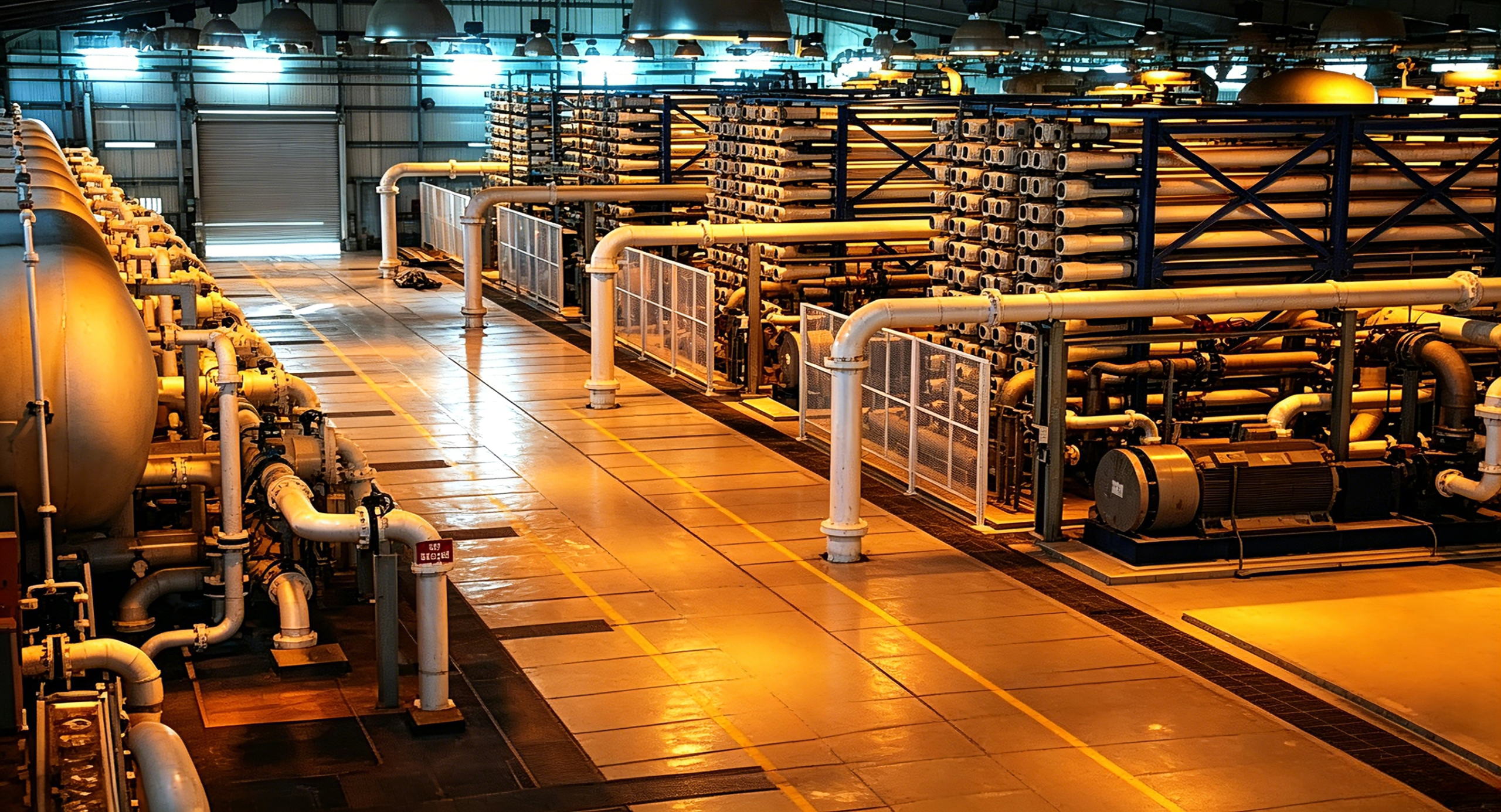
As global freshwater scarcity accelerates, industrial facilities, municipal authorities, and offshore operations increasingly rely on advanced desalination systems to secure reliable, high-purity water supplies. Modern Seawater Reverse Osmosis (SWRO) technology has emerged as the premier benchmark for efficiency, replacing high-energy thermal distillation methods with high-recovery membrane filtration.
This ultimate guide explores the end-to-end engineering architecture, technical specifications, energy-saving mechanisms, and structural considerations required for modern, top-tier industrial desalination systems.
What is an Industrial Desalination System?
An industrial desalination system is a specialized, multi-stage water purification plant designed to separate dissolved inorganic salts, minerals, suspended solids, and microbiological contaminants from saline raw water sources.
While brackish water applications typically handle Total Dissolved Solids (TDS) up to 10,000 mg/L, high-capacity seawater systems operate on raw feed water with TDS levels reaching 35,000 mg/L to 50,000 mg/L. Modern SWRO systems routinely achieve salt rejection rates exceeding 99.8%, converting harsh seawater into compliant municipal drinking water or ultra-pure industrial process water.
[Raw Water Intake] ➔ [Pretreatment & Filtration] ➔ [High-Pressure Pumping] ➔ [SWRO Membrane Separation] ➔ [Post-Treatment / Remineralization]Core System Architecture & Workflow Stages
To maintain structural longevity and prevent premature membrane fouling, a world-class desalination plant utilizes a meticulous five-stage purification pipeline:
1. Raw Water Intake & Screening
Seawater or high-salinity groundwater is drawn via beach wells, open-sea submerged intakes, or dedicated intake pump stations. Coarse trash racks and fine mesh screens physically filter out large debris, marine organism growth, and macro-particles before water enters the facility.
2. Multi-Tier Pretreatment Subsystem
Pretreatment is the frontline defense for preserving sensitive reverse osmosis membranes. Advanced setups incorporate:
- Dissolved Air Flotation (DAF): Removes algae, oil, grease, and colloidal organics.
- Dual Media / Multimedia Filters (DMF): Captures suspended matter to lower the Silt Density
- Ultrafiltration (UF) Skids: Serves as a pre-barrier against sub-micron particulates and bacteria.
- Chemical Dosing: Precise dosing of antiscalants, coagulants, and sodium bisulfite (SBS) neutralizes oxidants and prevents scale build-up.
3. High-Pressure Pumping & Energy Recovery
Overcoming natural osmotic pressure requires high operating pressures, typically ranging between 55 bar and 70 bar (800 to 1,000 psi). Heavy-duty high-pressure pump units (e.g., Grundfos, Sulzer) drive feed water into the membrane arrays. Integrated Energy Recovery Devices (ERD)—such as isobaric pressure exchangers (e.g., ERI)—capture kinetic energy from the high-pressure brine concentrate, returning up to 98% of that hydraulic energy to the feed stream to drop overall power requirements down to 2–3 kWh/m³.
4. Reverse Osmosis (RO) Membrane Separation
At the heart of the system, spiral-wound polyamide thin-film composite (TFC) membrane elements (e.g., Dupont FilmTec / Dow, Hydranautics) separate pure water molecules from dissolved salts. Permeate water passes through the central collector tube while the concentrated brine is safely rejected.
5. Post-Treatment & Remineralization
Permeate water from an RO membrane is slightly acidic and soft. Post-treatment steps involve gas stripping , pH adjustment, re-calcification, and UV or chlorine disinfection to ensure compliance with World Health Organization (WHO) or specific industrial process guidelines.
Engineering Standards: Reverse Osmosis vs. Thermal Desalination
When evaluating high-capacity desalination technologies, modern industrial plant operators evaluate life-cycle expenditures, footprint, and thermal demands.
| Feature / Metric | Seawater Reverse Osmosis (SWRO) | Multi-Stage Flash (MSF) / Thermal |
| Primary Energy Source | Electricity (Grid / Solar PV) | Thermal / Waste Steam |
| Specific Power Consumption | 2.0 – 4.0 kWh/m³ | 10.0 – 15.0 kWh/m³ |
| Salt Rejection Rate | Up to 99.8% | 99.9% |
| System Footprint | Compact, modular skid layout | Very large, heavy civil infrastructure |
| Max Feed TDS Handling | Up to 50,000 mg/L | 50,000 mg/L |
| Recovery Rate Range | 40% – 50% | 15% – 30% |
Critical Component & Material Standards
Operating in highly corrosive marine or high-salinity environments requires uncompromising material selection:
Material Breakdown for Marine Environments:
- High-Pressure Piping & Manifolds: Duplex 2205 or Super Duplex 2507 Stainless Steel to eliminate pitting corrosion.
- Pretreatment Vessels & Skids: Heavy-duty Fiber-Reinforced Plastic (FRP) or rubber-lined carbon steel.
- Pressure Vessels: 1,000 to 1,200 psi rated FRP membrane housings.
Smart Automation & Remote Operations
Modern enterprise-grade systems feature fully unattended, automated operation:
- PLC Architecture: Industrial controllers (e.g., Siemens S7-1500) manage automated flushing cycles, chemical dosing rates, and membrane cleaning-in-place (CIP) operations.
- IoT & 4G/5G Remote Monitoring: Real-time telemetry tracks permeate conductivity, transmembrane pressure (TMP), recovery rates, and differential pressure across pre-filter cartridges to trigger predictive maintenance.
Frequently Asked Questions (FAQ)
What is the lifespan of SWRO membranes in a desalination system?
With robust pretreatment, accurate chemical dosing, and periodic CIP procedures, industrial SWRO membrane elements typically maintain high performance for 3 to 5 years before replacement is required.
Can a desalination system operate on raw water with 50,000 mg/L TDS?
Yes. High-configuration SWRO plants engineered with Super Duplex high-pressure pumps, high-rejection membranes, and pressure exchanger ERDs are specifically designed to continuously treat raw water with TDS up to 50,000 while delivering clean water compliant with global drinking standards.
How does an Energy Recovery Device (ERD) lower operational expenses?
An isobaric pressure exchanger transfers the pressure energy from the concentrated reject brine stream directly to incoming feed water with up to 98% efficiency, reducing overall electrical consumption by 40% to 60% compared to systems without energy recovery.